Matthew Smith
|
Sep 02, 2021
|7.5 min read


Time zones can be difficult, whether it's video calling family on the other side of the world or causing so much frustration that a whole country changes its time zone to a neighbor’s (we feel you, Iceland). They can be a pain.
When it comes to business, however, being able to work across multiple time zones, especially being a web services provider like ourselves, is really useful and necessary. We need to be operational and be able to attend to our clients 24/7, and we want to have the diversity of thought and culture that makes ideas happen and life more interesting. All of these are reasons we have a global, fully remote team to keep the ship sailing smoothly.
This has real advantages for us (more on that here). However, it can also come with challenges. We have to consider that, as humans, we need sleep and a life, so we can’t work in a way that requires people to be constantly available in real time. Managing daily business across all time zones in a team requires us to view teamwork, communication, and operations a bit differently. We need to be able to work asynchronously.
Asynchronous communication is the art of working on and progressing tasks without needing each stakeholder to be present, without losing efficiency. Doing it well can benefit almost all organizations, whether they're multi-floored offices, co-located teams, or fully distributed teams (in which case, it’s vital).
Asynchronous working is not new. Anyone who has ever sent an email or left a Post-It note on someone’s desk has been working asynchronously. It's something we are all used to. However, as a remote team worldwide, we have to incorporate it into our processes and mentality. When working asynchronously, you have to always consider, “How would I complete this task, or move forward with this project, if all of my colleagues were away?”
Setting expectations is the fundamental step to working across multiple time zones. All team members should be encouraged to set their boundaries for when they can attend meetings, and it needs to be made clear that, with asynchronous work, immediate responses aren’t expected to instant messages or email. Without this clarity, you run a very real risk of burnout in your team.
It’s natural for people to hear a ping and respond to it. In a global organization, with pings from different time zones, this can make it impossible to switch off. Team members should be encouraged to turn off notifications outside their work hours, and processes and tools should be used to replace the need for urgent or real-time feedback from peers.
Another expectation that allows asynchronous work to really flex its muscles is autonomy. You don’t want to delay things unnecessarily whilst your team waits for a colleague on the other side of the world to wake up. Give your team the freedom to make informed decisions on projects and to prioritize their own tasks. You’ll avoid delays that come without this freedom.
In fact, setting these expectations could also yield additional benefits, most significantly, improved employee well-being.
Synchronous communication requires either having people available all the time or having the whole team work the same hours.
When you don’t have that expectation, the team can work hours that suit their schedule and life. It also means there is less pressure to be constantly on the ball, and with no expectation of immediate answers, they have fewer distractions and have more control over their workday.
When it comes to asynchronous working, these two are essentially the same thing. To communicate asynchronously means to document something, somewhere.
It’s best to adopt a policy of precise, direct communication. Provide as much context as possible in communications and project updates, and encourage your team to anticipate feedback and questions in their communications and address them upfront. This also helps avoid the annoying back-and-forth that can occur with asynchronous communication across time zones.
One simple way we can do this is to ask ourselves, “If someone were looking at this update for the first time, having just joined the company, would they understand what was going on?” If communication is clear to someone who lacks any prior context beyond the trail of documented communication, then it's good communication.
Documentation means that you have a knowledge trail. This can mitigate future delays or errors, and avoid confusion. You’ll have an information base for each project and task, and won’t lose context if someone leaves. It also means that new joiners can quickly get up to speed. All of this gives us more time to be more productive (and send GIFs).
It also makes us more considerate in what and how we communicate, promoting a solution-based mindset. When considering potential feedback upfront, you are more likely to find a problem to solve and not develop the habit of seeking immediate feedback from colleagues just because it’s easier.
Tools are our friends. Having the correct software or apps in place makes a huge difference.
Tools need to be carefully selected, and it works best when you have as close to “a single source of truth” as is feasible. Try to consolidate all information related to specific projects into a single platform. This makes it much easier for colleagues to progress, update, and track tasks without the need for real-time communication.
We are a “paperless” company, which is a necessity when working across different time zones. Google Drive is our answer to this. Any document anyone might need should be stored digitally, where they can access it without bothering a colleague at an unsuitable time for a certain contract or invoice.
Project management tools are used effectively. In our internal operations, we use Monday.com. It allows us to update projects, team tasks, and meeting agendas clearly and easily, making them the first port of call for status updates or task progress and history, rather than chasing a colleague or searching through emails or months-old messages.
Not least, you’ll need a company-wide communication platform. We use Slack. This is our most frequently used platform for async communication. It’s where all announcements and company updates are communicated, and it’s where decisions are most often made.
Using a written communication platform for announcements, to drive debate, and to make decisions makes it easier for everyone to be involved and aware of what's happening while working distributed. We also link our project management tools to Slack so that updates and progress are automatically communicated in project or team-specific Slack channels.
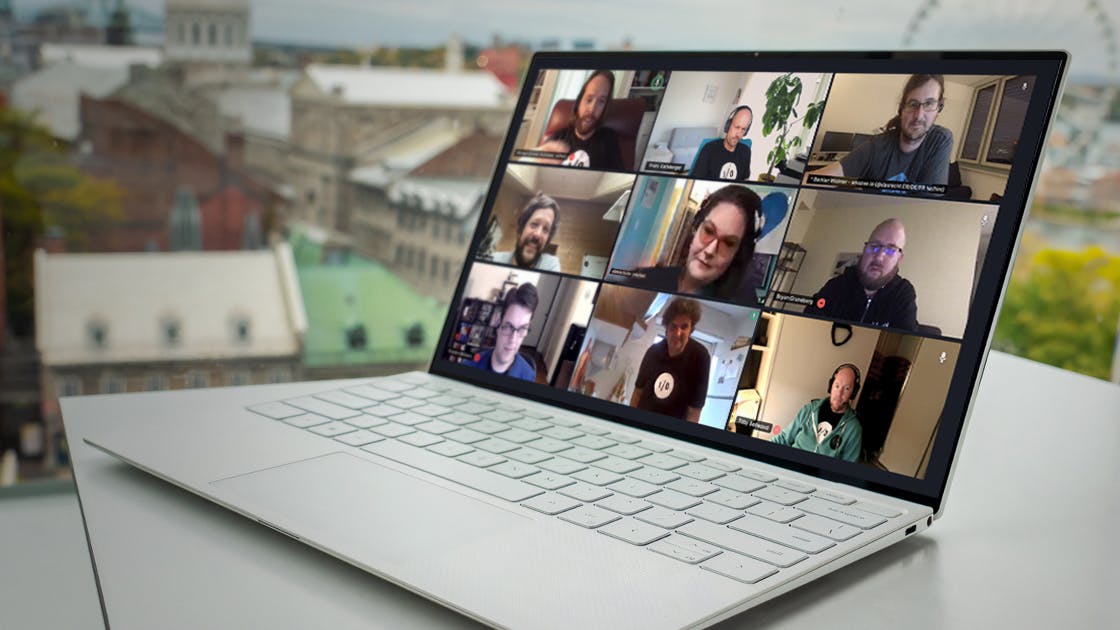
100% asynchronous working is perfect... for robots. However, it’s not great for those who have emotions and social needs, e.g., every human.
One thing we definitely don’t recommend is removing as much face-to-face interaction as you can and making everything about updating task lists and sending messages.
Limiting meetings, or at least restructuring them, is a practical step within a distributed setup.
We have teammates from New Zealand, England, and the US. This means we rarely communicate in a single company-wide meeting, and it should hopefully be obvious by now that one of the benefits of asynchronous communication is that you don’t have to rely on face-to-face meetings.
We do have face-to-face meetings, and they're still a large part of how we communicate—we don’t want to lose the human element that makes working with our colleagues enjoyable.
To accommodate a worldwide team, meetings can be split between time zones. For example, amazee.io has 3 social stand-ups a day, at times, which means at least 2 of the regions can join each meeting during their workday. We have a similar set-up for company-wide meetings and project teams.
There is sometimes a practical need to schedule meetings for less-than-ideal hours. This flexibility can sometimes be needed for a distributed team, but this should always be within reasonable hours. Acceptance shouldn’t be assumed; it should be checked for any colleagues who would be attending these meetings outside of their preferred work hours.
Small things can make a big difference, so we have some basic methods to give our distributed team that little bit more comfort when working across this big blue thing we call home.
Working in a distributed environment offers many advantages to a business, including fostering innovation and culture. To do it effectively whilst protecting employee wellbeing requires the art of asynchronous communication. There is always room for innovation and improvement, but it's fundamental to how we operate.
Like the sound of how we work? Get in touch with us. We’d love to hear from you!