Lauren Morris
|
Feb 18, 2025
|9 min read


In today's fast-paced digital landscape, user experience is paramount. Imagine you're in charge of an enterprise e-commerce presence, and suddenly, the complaints start flooding in. The website is sluggish, customers abandon their carts, and orders aren’t processed. Every minute of downtime equates to lost revenue and frustrated customers. How do you quickly identify and resolve the issues?
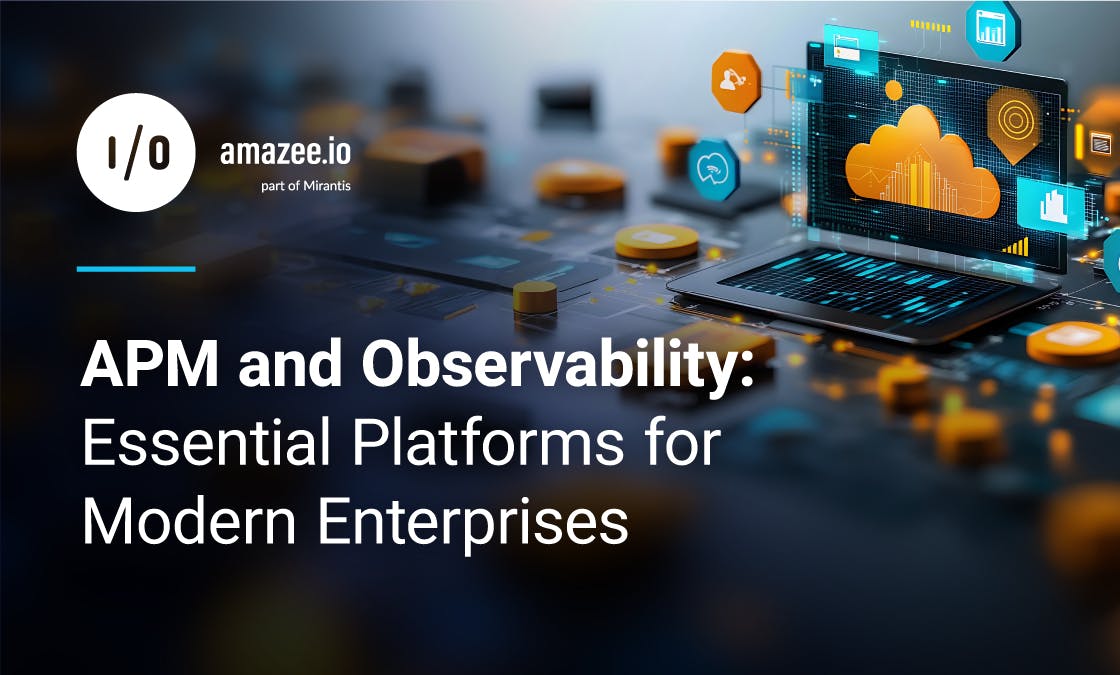
This is where Application Performance Monitoring/Management (APM) and Observability come into play. While often mentioned in the same breath, they serve distinct purposes. Understanding the differences between APM and Observability - and how they reinforce each other- is critical for maintaining the health of today’s complex IT environments.
At its core, APM is about monitoring and managing application performance, tracking and radiating metrics such as response times, error rates, and throughput to help detect and diagnose application issues. For example, APM tools can be configured to track load time and alert you if a critical web page takes too long to load or if error rates spike after deploying a new version.
Discover our article, where we explain uptime monitoring in detail.
Observability helps teams understand what's happening inside their systems by going beyond surface-level monitoring. It provides deep, granular insights into your entire technology stack through three key components: metrics, logs, and traces - known as the three pillars of Observability.
| Aspect | APM | Observability |
|---|---|---|
| Focus | Tracking the health and analyzing the performance of specific system/IT infra components and applications based on predefined metrics. | Understanding the behavior and state of the entire system through telemetry data. |
| Data Types | Metrics | Metrics, logs, traces |
| Approach | Reactive—alerts based on thresholds. | Proactive—exploring data to ask new questions. |
| Use Cases | Detecting performance issues and alerting. | Root cause analysis, understanding complex interactions. |
| Complex Environments | Limited insights into distributed systems. | Designed for microservices and cloud native architectures. |
| Scalability | Scales well for monolithic applications but may face challenges with highly distributed architectures. | Designed to handle the complexity and scale of modern, distributed architectures with multiple components and microservices. |
While APM provides essential monitoring of known metrics, Observability enables more profound insights into complex, distributed environments. Together, they offer a comprehensive view of your systems, allowing for both immediate detection and in-depth analysis of issues.
Modern enterprises increasingly adopt cloud-native architectures, leveraging technologies like Microservices, Kubernetes, and serverless functions. While these technologies offer scalability and flexibility, they also introduce complexity. Challenges include:
In such environments, issues often arise not from a single point of failure but from unpredictable interactions between components. Traditional monitoring, such as APM, falls short in these scenarios, necessitating a shift towards Observability.
Modern Observability solutions unify data from logs, metrics, and traces to provide deep insights into the full stack. They allow teams to:
For example, Observability enables tracing a single user request across dozens of microservices, identifying exactly where performance degrades. By overlaying contextual data such as pod metrics, node health, and deployment events, you can uncover and address complex failure modes.
Artificial intelligence (AI) and machine learning (ML) are transforming Observability by automating anomaly detection, predicting potential issues, and assisting in root cause analysis.
Example: Platforms like Dynatrace use AI-driven problem detection to enhance operational efficiency.
Standardization Efforts: OpenTelemetry is becoming the industry standard for collecting and correlating telemetry data, providing vendor-neutral instrumentation.
With enterprises operating across multiple clouds and on-premises data centers, achieving unified Observability is challenging but critical.
Organizations can use these capabilities to fix problems faster, improve user experiences, and make more informed decisions about changes.
For example, read our article "A Large Credential Stuffing Attack" as an illustration of using observability tooling to uncover a large credential stuffing attack.
Define Clear Objectives:
Foster Cross-Team Collaboration:
Integrate with CI/CD Pipelines:
Leverage Open Standards:
Continuously Refine Dashboards and Alerts:
Invest in Training and Culture:
Dig Deeper: Learn more about CI/CD
At amazee.io, we understand that you know your business best. We offer the flexibility to integrate your preferred APM and Observability platform into a fully managed dedicated Platform-as-a-Service without vendor lock-in.
Our Commitment:
Dig deeper with our article, GitOps vs. DevOps, to learn how you can create a powerful and efficient software delivery pipeline.
In an era where user experience directly impacts business success, APM and Observability are no longer optional but essential. By combining proactive monitoring with deep system insights, enterprises can ensure optimal performance, quickly resolve issues and deliver exceptional customer experiences.
At amazee.io, we're here to partner with you on this journey and handle the heavy lifting so you can focus on your enterprise goals. Contact us today to explore how we can tailor our platform and expertise to meet your unique needs.