Daniel Lemon
|
Feb 04, 2026
|7 min read


A fully managed, secure data hosting service is an enterprise-grade solution in which the provider assumes 24/7/365 responsibility for infrastructure, proactive patching, and regulatory compliance, effectively transferring operational risk away from the client.
Do you find that more of your or your engineering team’s time is being devoted to managing security? Looking after security in-house is a continuous, high-stakes responsibility that requires constant vigilance to stay on top of things. Activities like 24/7 monitoring, emergency patching, compliance checks, and incident response are a must, but also consume valuable engineering resources, distract from strategic initiatives, and introduce financial, legal, and reputational risk if anything goes wrong.
Expecting internal teams to keep up with evolving threats while maintaining enterprise-grade uptime and regulatory compliance can feel unsustainable. Security teams can be overwhelmed by the sheer volume of alerts, patches, and audits. Taking all this into account, fully managed secure data hosting is a win-win. By transferring responsibility to specialized experts, you can mitigate risk, streamline operations, and regain focus on growth and development. For many companies, adopting a fully managed, secure data hosting service is not a cost decision but a risk strategy.
Keeping on top of security requires around-the-clock monitoring and response. For internal teams, this can mean constant context switching, alert fatigue, and inevitable blind spots. Even organizations with strong security cultures struggle to maintain consistent, high-quality coverage without operational gaps. This is precisely where secure managed hosting delivers value: it absorbs the operational load while maintaining continuous security oversight.
Downtime and security incidents can result in considerable financial consequences, including lost revenue, customer churn, regulatory fines, and potential legal trouble. That’s not to mention the damage to customer trust and to your brand, the ramifications of which can persist for far longer. When compliance failures intersect with breaches, the penalties and exposure multiply, turning your short-term savings from self-managed hosting into long-term, compounded losses.
Modern threats are automated, sophisticated, and relentless. If you’re relying on “good enough” security, like firewalls, periodic patching, and reactive monitoring, you’re putting your organization at risk. Protecting enterprise data requires deep expertise, layered defenses, and continuous oversight. A fully managed, secure data hosting service can keep pace with evolving attack surfaces while minimizing risk to mission-critical applications. Enterprises operating customer-facing or regulated platforms increasingly rely on managed hosting security as a baseline requirement. It can’t be treated as a “premium” feature.
Top-tier managed hosting is built on three essential pillars that deliver both security and operational resilience.
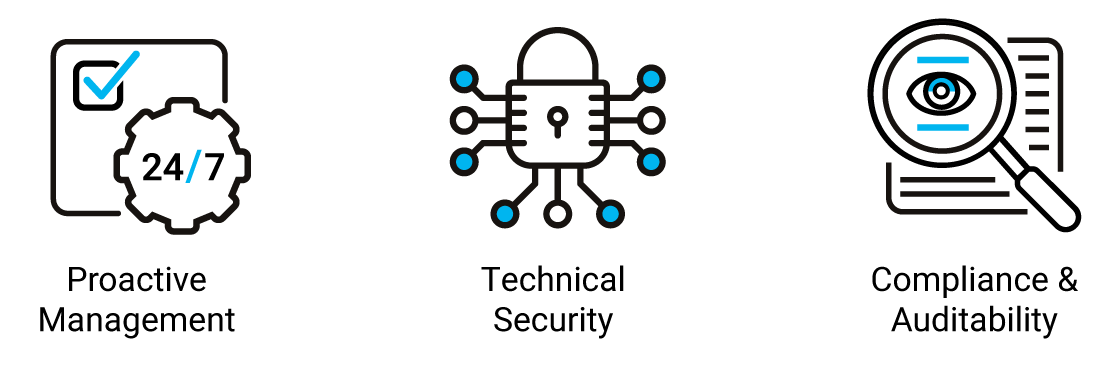
With secure managed hosting, security is handled before issues even arise. This includes 24/7/365 monitoring, automated patching, infrastructure maintenance, and rapid incident response. Every potential vulnerability is addressed preemptively, relieving internal teams of the constant burden and ensuring uninterrupted service.
→ Dig deeper and learn how we did this for Switzerland's largest open-air event: Prepare your website for high-traffic events
Effective enterprise hosting includes security at every layer. Core capabilities include advanced encryption (at rest and in transit), DDoS protection, Web Application Firewalls (WAF), and network segmentation. Isolation is critical, as without it, a single compromised component can endanger the entire application stack.
Enterprises must be compliant with standards such as GDPR, HIPAA, and ISO. Managed hosting should deliver built-in auditability, clear documentation, and repeatable controls. Compliance should be automatic and verifiable, not an afterthought.
→ Learn more about our IOS and SOC-certified, secure Drupal hosting
Drupal is a powerful and flexible open source CMS, but its architecture and ecosystem create unique security challenges. As a result, Drupal is particularly well-suited to a managed, secure data hosting service that can absorb its architectural complexity without compromising security or uptime.
Drupal’s open source nature allows organizations to build highly customized digital experiences by integrating a wide array of different modules and third-party extensions. While this flexibility is a strength, it significantly expands the attack surface. Each additional module is a potential vulnerability, and outdated modules or unpatched core updates can become security risks. In many enterprises, even a single unpatched module can expose sensitive data or serve as an entry point for attackers. Maintaining a secure and up-to-date Drupal environment requires constant vigilance: tracking security advisories, verifying patches, testing updates, and deploying them without disrupting the live site; a process that demands dedicated expertise and resources.
Drupal applications rely heavily on relational databases to manage structured content, user data, and configuration. This makes database security critical, as any compromise at the database layer can expose sensitive information across the site or application.
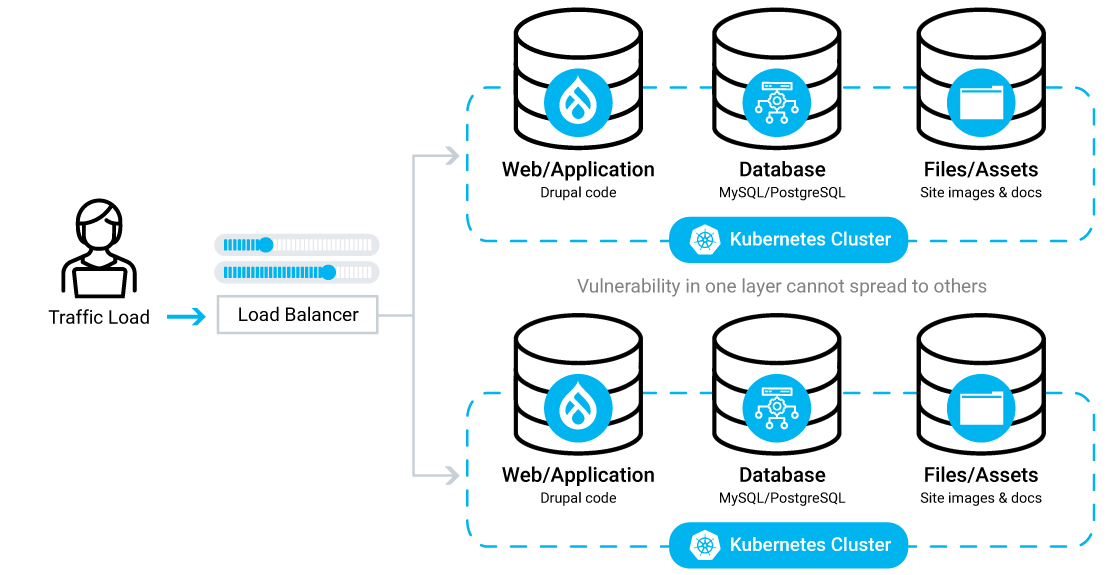
To manage this risk, it is essential to isolate the database from the web application layer. Without proper separation, a vulnerability in the web-facing code could allow external access to the database. Layered isolation ensures that even if one component is compromised, the attacker cannot access the others. This separation also simplifies backup, disaster recovery, and compliance reporting, as each layer can be secured, monitored, and audited independently.
Drupal’s modular architecture includes a sophisticated, interconnected dependency tree. Core updates often cascade across multiple contributed modules, which may, in turn, rely on additional third-party libraries. Patching a single component without accounting for these dependencies can introduce functional errors, downtime, or even new vulnerabilities.
For DevOps and IT teams, this complexity translates into significant operational overhead. Every update requires careful testing in a staging environment, rollback planning, and continuous monitoring post-deployment. Automating these processes helps, but without a fully managed, secure data hosting framework, even automated pipelines struggle to keep pace with Drupal’s evolving ecosystem. Enterprises relying solely on internal resources face the constant challenge of balancing security, stability, and operational efficiency.
amazee.io leverages container-based infrastructure and Kubernetes orchestration to isolate each component of a Drupal application. Web code, databases, and assets run in separate containers, ensuring that vulnerabilities in one component cannot spread. This architecture directly addresses Drupal’s complexity and operational risk, providing a robust security posture by design.
Open source infrastructure eliminates the opacity of proprietary platforms. Every layer is inspectable, verifiable, and continuously improved by the community. Transparency becomes a security asset, turning visibility and auditability into tangible protection for enterprise applications.
amazee.io takes care of updating and keeping the platform and associated programs up to date and secure. Every action is logged and auditable, providing a complete and verifiable history for internal review or regulatory purposes.
As a secure managed hosting service purpose-built for enterprise Drupal, amazee.io delivers security, compliance, and operational resilience as a single, integrated offering.
Choosing amazee.io shifts the burden of uptime, patching, monitoring, and compliance to our expert team, allowing your team to regain focus on what matters, prioritizing development instead of tackling operational and security issues.
Resilient hosting combines availability, security, recoverability, and compliance into a single service. Mission-critical Drupal applications remain protected from both operational failure and external threats, ensuring business continuity without constant oversight.
Enterprises ready to reduce risk, simplify compliance, and regain engineering focus can take the next step by exploring fully managed, secure Drupal hosting with amazee.io.
Stop letting security maintenance stall your development roadmap. Transition to a fully managed, secured data hosting service built for the specific demands of enterprise Drupal. Partner with amazee.io to achieve a resilient, compliant, and transparent hosting environment that scales with your business.